MANAGEMENT MODELS BASED ON FUZZY CLASSIFICATION OF TECHNOLOGICAL OBJECT STATES
 Abstract views: 143
/
Abstract views: 143
/  PDF downloads: 75
DOI:
https://doi.org/10.5281/zenodo.18116455Keywords:
management models, state classification, technological object, multi-valued (fuzzy) logicAbstract
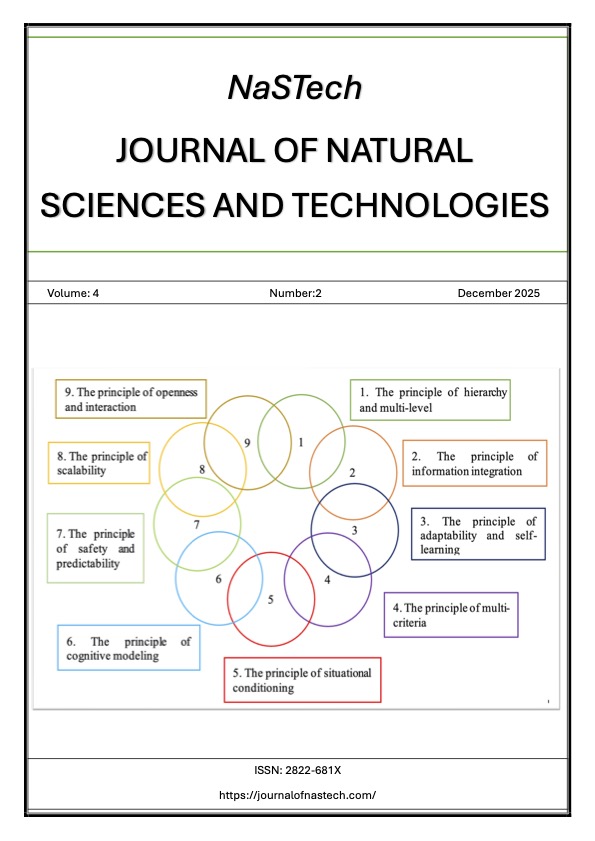
The article proposes a principle of situational management implemented on the basis of fuzzy classification of states of technological objects using fuzzy cluster analysis. The results obtained in the work are the theoretical basis for the development of models for technological process management in the production of technical automation equipment in conditions of insufficient and/or fuzzy information.
References
Katrenko, A.V. System Analysis: Textbook. Lviv: Novyi Svit – 2000, 2024. 396 p.
Domarev, V.V. Situational Management System: Theory, Methodology, Recommendations. Kyiv, 2017. 347 p.
Trofymchuk O.M., Kryazhych O.O. Algorithmic basis of situational management. Informatics and System Sciences: materials of the VI All-Ukrainian Scientific and Practical Conference, Poltava, March 19-21, 2015. pp. 351-353.
Polyanska, A.S. Use of the Situational Approach in Enterprise Development Management: Monograph. Ivano-Frankivsk: Akcent, 2011. 432 p.
Babaev V.M., Pazinich S.M., Ponomarev A.S. Logic for Engineers. Kharkiv: KNAMG, 2007. 537 p.
Bidiuk P. I., Terentyev O. M., Prosiankina-Zharova T. I. Applied statistics. Vinnytsia: PP “TD” Edelweiss and K", 2013. 304 p.
Zheldak T.A., Koryashkina L.S., Us S.A. Fuzzy sets in control and decision-making systems: edited by S.A. Us; Ministry of Education and Science of Ukraine, National Technical University “Dnipro Polytechnic”. Dnipro: NTU “DP”, 2020. 387 p.
Ivakhnenko A.G. Inductive method of self-organization of complex system models. Kyiv: Naukova Dumka, 1981. 296 p.
Vyklyuk, Y. I., Kaminsky, R. M., Pasichnyk, V. V. Modeling of complex systems. Lviv: Publishing House “Novyi Svit – 2000,” 2020. 404 p.
Ivakhnenko A. G., Madala H. R. Inductive learning algorithms for complex systems modeling. New York: Boca Raton, CRC Press, 1994. 384 p.
Kutkovetsky V. Ya. Image recognition. Mykolaiv: Petro Mohyla Black Sea National University Publishing House, 2017. 420 p.
Makarenko G. S., Starodubtsev M. G., Shibanov S. V. Selection of control actions based on operational identification of a technological object. Computer-integrated technologies, automation, and robotics: materials from the II All-Ukrainian Conference, Kharkiv, May 16-17, 2025. P. 76-79.
Published
How to Cite
Issue
Section
License
Copyright (c) 2026 Journal of Natural Sciences and Technologies

This work is licensed under a Creative Commons Attribution 4.0 International License.